











A behind-the-scenes case study in scenic fabrication, environmental design, balloon installation, collaboration, and large-scale event production.
The Project
What does it take to transform an ordinary event space into a world guests can step inside?
In the summer of 2026, Salem Balloons & Flowers traveled from Oregon to Houston, Texas, to participate in the hands-on production and installation of a large-scale collaborative immersive event inspired by a magical wizarding world.
The project began with an essentially empty warehouse and evolved into a completely different environment filled with scenic architecture, themed storefronts, custom flooring, overhead installations, dimensional props, balloons, florals, lighting, styled dining environments, and countless smaller details.
Rather than simply decorating an existing room, the production demonstrated what happens when the environment itself becomes a fantasy world for the guests to experience.
Creating a World, Not Decorating a Room
Traditional event décor introduces decorative elements into an existing space.
Immersive event design goes further.
For an immersive environment to feel convincing, the individual elements cannot be treated as isolated decorations. Scenery, architecture, flooring, lighting, props, balloons, florals, furnishings, and overhead installations must visually relate to one another.
Entrances become transitions. Walls become scenery. Empty corners become destinations. Flooring contributes to the illusion. Elements above the guests help define the world around them.
The objective is no longer simply to make the room beautiful.
The objective is to make guests temporarily forget the room that was there before.
The room is no longer simply the place where the event happens. The room becomes part of the story.
From Vision to Visualization
Before construction began, the immersive environment existed digitally.
A 3D visualization brought the creative concept into a spatial environment, allowing the overall experience, architecture, scenery, scale, color, and relationships between major design elements to be explored before physical production began.
For immersive event design, this stage is more than creating a beautiful preview. Visualization helps translate creative ideas into a plan that can be evaluated, refined, and ultimately built.
Before the world could be constructed, it first had to be visualized.
 →
→ 
Starting With an Empty Warehouse
Before the storefronts, balloons, lights, props, and finished photographs, there was an empty industrial space.

Large scenic environments began as lumber, structural frames, printed materials, tools, measurements, and individual components spread throughout the warehouse.
Frames were constructed on the floor before being raised into position. Scenic materials had to be aligned and secured. Architectural sections had to connect. Flooring needed to work with the surrounding scenery. Dimensional details were added gradually as the individual pieces began forming recognizable environments.


Seeing the project at this stage revealed something that finished event photographs rarely communicate:
Large-scale immersive transformations are not simply installed...
They are built!
Building the Scenic Environment
One of the most striking environments within the project was a colorful candy-shop-inspired storefront and interior.
Its transformation illustrates how scenic design can make an ordinary event space visually disappear.
Large-format sublimation fabric created richly detailed walls and architectural surfaces, while structural framing gave those scenic elements physical presence within the room.
Dimensional features, including a striped awning, storefront details, flooring, displays, props, lighting, and decorative elements, added additional layers to the illusion.
Individually, each component was only one piece of the environment.
Together, they created somewhere that felt entirely different from the warehouse in which it had been constructed.

Creating Depth and Believability
A believable immersive environment depends on layers.
Printed scenery can establish the visual world, but dimensional elements help bring that world forward into the physical space.
Architecture creates boundaries and scale. Flooring changes what guests see beneath them. Lighting changes the atmosphere. Props occupy the foreground. Overhead installations expand the experience above eye level. Florals, balloons, furnishings, displays, and smaller details fill the spaces between the larger scenic elements.
The more intentionally those layers interact, the less attention guests give to the original room behind them.
That is where themed décor begins to become an immersive environment.


When Balloons Become Scenic Elements
Balloons played an important role throughout the transformation, but not simply as traditional balloon decorations.
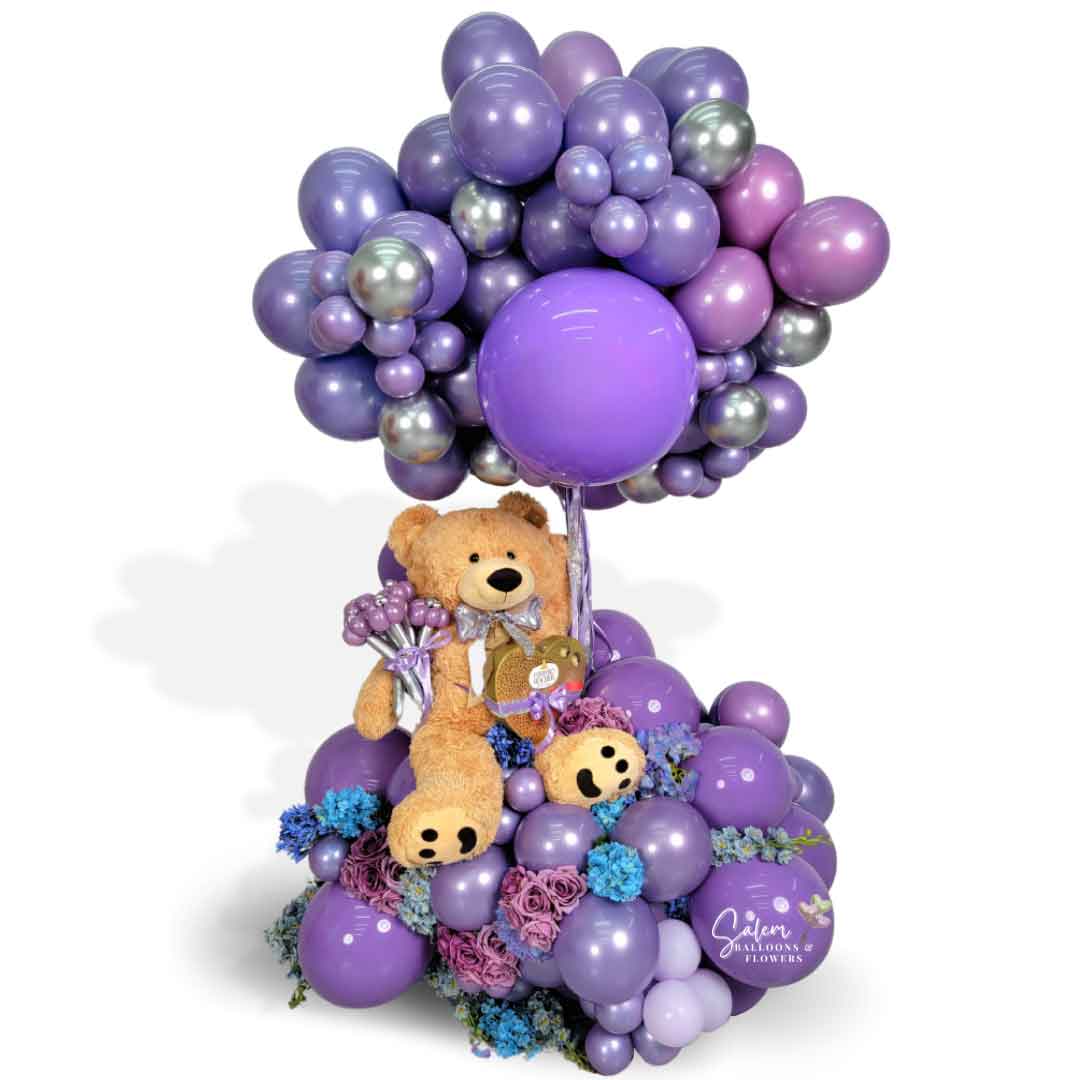
Oversized spheres, patterned balloons, suspended installations, coordinated color palettes, and large-scale balloon compositions became part of the visual architecture of the event.
Their scale mattered.
In an environment filled with large scenic structures, ordinary-sized decorative elements could easily disappear. Oversized balloon elements helped maintain the proportions of the surrounding scenery while adding movement, softness, color, and dimension.
This is one of the principles that can make immersive event design so different from traditional balloon décor.
The balloon installation does not necessarily need to be the centerpiece.
Sometimes, balloons become one of many materials used to make the larger world believable.


The Reality Behind Large-Scale Immersive Production
Finished photographs can make an immersive event appear almost effortless, but the reality behind the scenes is very different.
Large-scale transformations require significant time, venue access, sequencing, communication, installation planning, material knowledge, skilled hands, creative problem-solving, and coordination among many moving pieces.
One installation decision can affect another.
A scenic panel must align correctly with the structure supporting it. Flooring must meet scenery convincingly while keeping safety as a priority. Dimensional elements must be positioned without interfering with guest movement. Large installations must account for scale, stability, access, photography, and sightlines.
Even seemingly small installation details can influence the finished illusion.
This is one reason immersive transformations require considerably more planning and production time than conventional event décor.
A Collaborative Production
Large-scale immersive environments require many hands and multiple areas of expertise.
Scenic fabrication, structural elements, graphics, décor, balloons, florals, lighting, furnishings, installation, and logistics must ultimately come together within one physical environment. Successful collaboration allows each specialty to contribute to a larger, cohesive vision.
This project reinforced something we believe strongly at Salem Balloons & Flowers: creative talent is only one part of creating an immersive experience.
Transforming a space also requires an understanding of scale, proportion, spatial relationships, sightlines, guest movement, materials, installation sequencing, and how individual design elements interact within the environment.
These principles are not new to our design approach. They are rooted in our Interior Design background and are fundamental to the way we evaluate and develop immersive environments.
A project of this magnitude may require a team of fabricators, installers, specialty vendors, rental partners, florists, balloon professionals, graphic producers, and other creative collaborators. Just as important, a multidisciplinary team requires skilled, experienced leadership capable of anticipating challenges, establishing an effective production sequence, communicating expectations clearly, coordinating specialties, and making informed decisions as the transformation takes shape.
Experience alone is not enough. Effective leadership combines experience with knowledge, skill, preparation, and sound judgment, using lessons from previous productions to prevent avoidable problems rather than simply becoming proficient at responding to them.
Immersive design may take a village to produce. But it still requires a clear vision, thoughtful planning, design knowledge, and skilled, experienced leadership to bring all those moving pieces together.
The Transformation
Eventually, the lumber disappeared. The warehouse walls receded behind scenery.
The unfinished structural frames became storefronts and architectural environments.
The flooring, props, balloons, florals, furnishings, lighting, and overhead elements filled the spaces between them.
What had begun as an empty industrial environment became a colorful, dimensional wizard-inspired world designed to be explored, photographed, and experienced by guests.
The contrast between the original space and the completed environment demonstrates one of the most powerful aspects of immersive event design:
The venue provides the physical space. The transformation gives that space another identity.
→
 →
→ 
 →
→ 
 →
→ 
 →
→ 
An empty room is simply the starting point.
With the right concept, scenery, fabrication, décor, lighting, spatial planning, creative direction, and organized production, that room can become a romantic garden, an enchanted forest, a storybook village, a fantasy kingdom, a period-inspired setting, or an original world created specifically for a celebration.
Not every Immersive Event needs to transform an entire room.
Some celebrations call for one extraordinary environment within a larger event, while others invite the story to unfold throughout the primary contracted space.
The scale may change, but the principle remains the same.
The goal isn't to fill the room. The goal is to make the world believable.
Ready to Step Into a World of Your Own?
Discover Salem Balloons & Flowers' Immersive Themed Event Design service and learn about Focused and Full Immersive Transformations.

